
New models run privately and offline on everyday devices, with TranslatePsy-AfriSLM outperforming far larger systems, opening a path to local-language education and health knowledge for underserved communities across Africa; a parallel TranslatePsy-EuroNano release brings the same technology to nine European languages
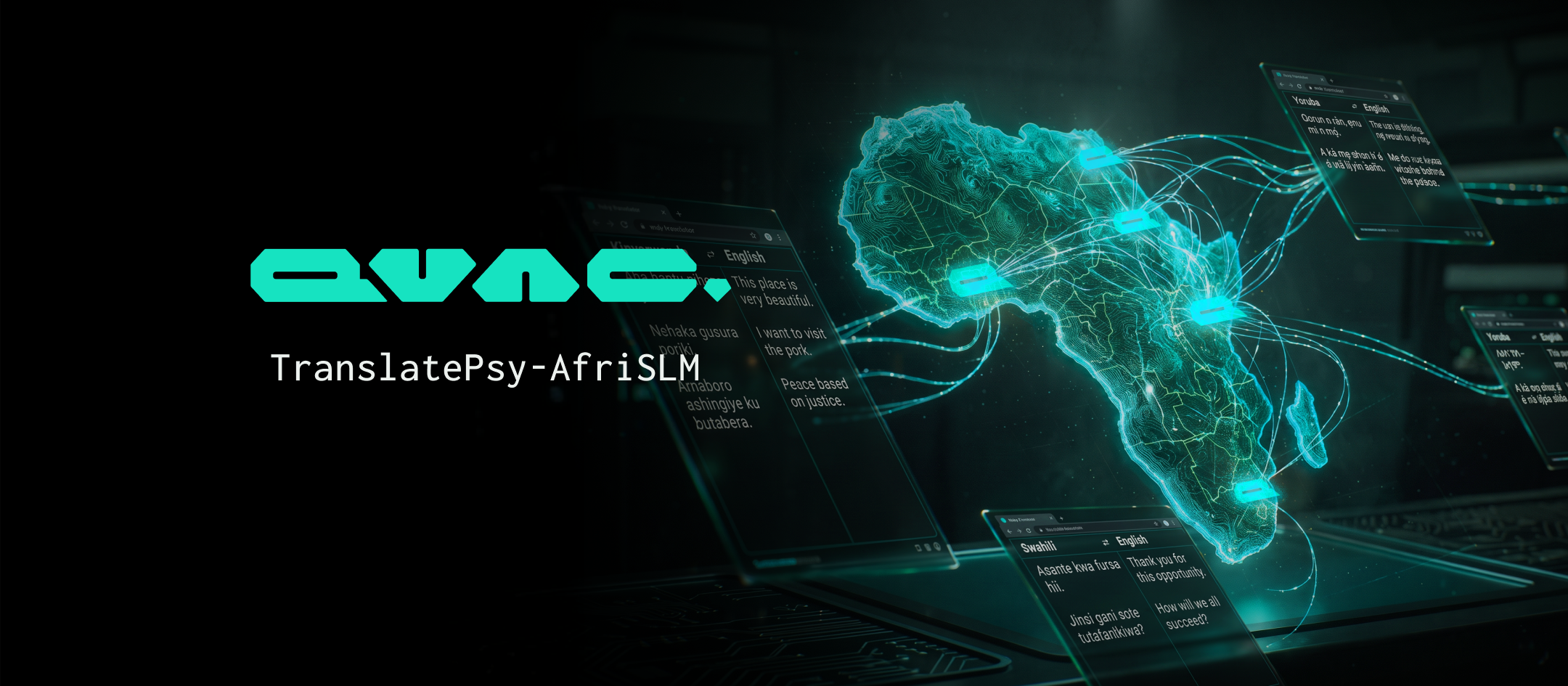
2 September 2026 – Tether AI Research today announced the launch of new families of open-source AI translation models designed to run directly on smartphones, laptops, and other edge devices with a primary focus on Sub-Saharan Africa. The release includes QVAC TranslatePsy-AfriSLM and QVAC TranslatePsy-AfriNano, supporting 19 and 8 African languages respectively, alongside QVAC TranslatePsy-EuroNano covering 9 European languages.
By processing translations locally, the TranslatePsy models can operate without an internet connection while keeping users’ data on their devices rather than sending it to third-party cloud servers.
What Translation Unlocks For The Underserved
For hundreds of millions of people across Africa, one of the barriers to modern AI is language. The most powerful tools run in a few major languages and depend on the cloud, putting them out of reach for many.
TranslatePsy-AfriSLM supports Hausa, Amharic, Yoruba, Lingala, Swahili, Igbo, Zulu, Somali, Oromo, Malagasy, Kinyarwanda, Xhosa, Afrikaans, Wolof, Luganda, Nyanja, Shona, Tswana, and Southern Sotho. Together, these languages span West, East, Central, and Southern Africa and represent roughly half of Africa’s population.
Translation across 19 African languages can unlock the ability to deliver courses, educational content, scientific material, and AI-powered learning tools directly to children and adults in their own languages.
Despite containing just 800 million parameters, the smallest TranslatePsy-AfriSLM model outperformed Qwen3.5-122B-A10B, TranslateGemma-27B, and NLLB-3.3B across the FLORES-200, BOUQuET, and SMOL translation benchmarks.
A key innovation is the introduction of a new quality-estimation filtering method that removes up to 96% of low-quality open-source training data. By improving the quality of the underlying data, Tether AI Research was able to achieve stronger translation performance with significantly smaller models.
Healthcare will be one of the highest-impact applications. Patients may speak different local languages, while connectivity can be unreliable in the communities that need information most.
Combined with Tether QVAC MedPsy, a small foundation model for medical and healthcare applications, TranslatePsy-AfriSLM creates a potential pathway to deliver medical knowledge and health education in the local languages of hundreds of millions of people.
Such systems would require appropriate safeguards and clear boundaries between health education and clinical care, but the potential impact is substantial.
Agriculture, Humanitarian Response, and Cross-Border Communication
The applications extend well beyond education and healthcare. Farmers could receive agricultural information in local languages, helping translate technical knowledge into practical guidance. In humanitarian and disaster-response settings, where camps and affected areas may have poor connectivity.
For NGOs and field organizations, local-language translation could help field workers communicate across multiple communities without carrying separate translation systems for every language.
Tether has spent years building physical touchpoints in these communities. Across Sub-Saharan Africa, its solar-powered kiosks let residents charge a phone, swap a battery, and access digital financial services where the grid and the banking system do not reach. Those same hubs could become places where a family charges a phone by day and, by evening, where children watch a science documentary in their own language, or parents learn new farming techniques from a local-language video, turning a charging point into a point of access to knowledge.
The Same Approach, Applied in Europe
The same design principle underpins a parallel release for European languages. Tether AI Research’s TranslatePsy-EuroNano replaces dozens of separate bilingual models with two compact multilingual models per performance tier. Using English as a pivot, the models support 90 translation directions across nine European languages. The smallest deployment requires just 36MB of storage, compared with 633MB for an equivalent Firefox offline translation configuration, reducing storage requirements by approximately 94%.
TranslatePsy-EuroNano, the highest-quality model in the European family, retained 98.4% of Meta’s NLLB-200 translation quality when translating into English while using a fraction of the storage required by larger systems.
“Four billion people were left behind by the traditional financial system, and the most powerful technology of our age has repeated that failure,” said Paolo Ardoino, CEO of Tether. “Language should not determine who can benefit from artificial intelligence. Open translation models like these are a step toward a future where education and AI tools reach hundreds of millions of people who have neither reliable connectivity nor access to expensive systems. A mother could get real medical information she understands, instead of guessing. A child could learn in their own language. That is the future we are building through QVAC.”
TranslatePsy-AfriSLM is available for download on Hugging Face at this link, in three sizes (full-precision and smaller quantized versions):
- qvac/TranslatePsy-AfriSLM-0.8B
- qvac/TranslatePsy-AfriSLM-2B
- qvac/TranslatePsy-AfriSLM-4B
TranslatePsy-Nano is available for download on Hugging Face at this link: https://huggingface.co/collections/qvac/translatepsy-nano. It supports both European and African language translation, with models offered in full-precision and quantized versions: :
- qvac/TranslatePsy-EuroNano
- qvac/TranslatePsy-AfriNano
The research underpinning TranslatePsy-AfriSLM has also been accepted for presentation at the Empirical Methods in Natural Language Processing (EMNLP) 2026 conference.
About Tether AI Research
Tether AI Research is part of Tether’s broader vision to advance freedom, transparency, and innovation through technology. Its mission is to enable people and organizations to connect and share information directly, without unnecessary intermediaries. By creating secure, peer-to-peer systems, Tether AI Research gives users greater control over their data, communications, and digital interactions. Tether AI Research aims to redefine how information flows across networks by replacing centralized models with decentralized infrastructure designed for privacy, efficiency, and resilience.
*References to Tether AI Research mean Tether Data, S.A. de C.V.
About QVAC
QVAC is Tether’s advanced AI research initiative dedicated to building open, decentralized, and adaptive intelligence systems. Its mission is Local AI and Infinite Intelligence. It is guided by an uncompromising vision of a world where AI lives and learns on any device, empowering individuals and communities rather than concentrating power in corporate data centers.